|
A lechero circa 1800s
|
I never expected to become a lechero (a milkman), or a quesero (a cheesemaker), and much less a fromager (a cheesemonger).
Yet I have become all three as I cross into my sixties.
In 2014, after a failed venture growing organic sweet corn, losing more than a million pesos in the gambit, our town's patron Santa Maria Magdalena, so it seemed, lit me a path of recovery with a challenge.
As a lapsed, when-I-feel-like-it Catholic, I am not a particularly religious person prone to spiritualizing good fortune, nor am I one to petition God for a venture's favorable outcome. In retrospect, however, Heaven (again, so it seemed) handed me a divine mission. Despite a somewhat false reputation as a capable salesman, I was "blessed" with a near impossible mission to help a desperate band of dairy farmers profitably dispose of their 700 liters of gatas ng kalabaw within a week!
Our town's agriculture officer, Cecille Sy, approached me, seeking help in selling the looming milk harvest of carabao dairy farmers from Magdalena, Laguna. They were anticipating a dramatic rise in milk production with the expected birth of new calves from about a dozen of gestating carabaos.
On average, a dairy carabao produces between 3 and 6 liters of milk a day, 30 to 40 liters per week, for about 300 days in a full year. A dozen lactating carabaos could thus bring an additional 21 to 42 liters a day.
 |
| A dairy carabao of the Murrah variety |
In addition to the daily collective yield of some 30 liters per day, or 210 liters per week, the additional yield could reach 500 liters per week. As it was, the farmers were already struggling to sell less than 100 liters weekly, what more 500 liters or so per week?
It was not a simple problem to solve just by selling milk to individuals through retail. How many households would you sell to, if you could, in a week? Moreover, carabao milk was three times more expensive than the more affordable and accessible cow's milk.
Besides, my sales experience then was limited to three days selling sweet corn at a food fair, and to top it all, I had absolutely no experience selling dairy products.
It was a mission, however, that I had to accept. If the milk was not sold within a week of harvesting, even if frozen, most would curdle, if not spoil. The milk would be rendered unsellable in liquid form, and farmers would lose much-needed income.

|
| Statue at the Parish Church |
Providentially, Santa Maria Magdalena did intercede. On my very first milk-selling foray, I found a buyer. Not a drop of milk was wasted. In the coming week, 700 liters of gatas would bring joy to scores of pizza and Burrata lovers. The milk would be transformed into over a hundred kilos of creamy, silky mozzarella de kalabaw made by the Gino's Brick Oven Pizza chain.
The wise counsel of an old friend and mentor, Luz de Leon, and the timely assistance of Ms. Amy Besa (of Purple Yam fame), helped me complete my mission.
I was introduced to Jutes Templo, the pizza restaurateur, who desperately needed carabao milk on the very same weekend the farmers’ milk harvest had to be disposed of. In common desperation, one group's problem became another person’s solution.
That is how my journey toward becoming a cheesemonger started, helping carabao dairy farmers sell their milk and finding a pizza restaurateur who needed them to make cheese. To this day, it has been my continuing mission to help both farmers and consumers. Little did I know that my efforts would have a social and economic impact on our fifth-class municipality with a poverty incidence of 16.5% .
But in the past seven years, the prospect of wasted milk and income loss would be a constant threat. So, to mitigate the threat, I ventured into becoming a quesero and a fromager to extend the nutritional and economic value of carabao milk in the form of cheese.
 |
MAGCO members
|
Michael Rodriguez, a high school batchmate, gentleman farmer, and gourmand had travelled to Turkey where he discovered halloumi. He introduced me to it and suggested that I make the halloumi with carabao milk instead of its traditional base of sheep or goat milk.
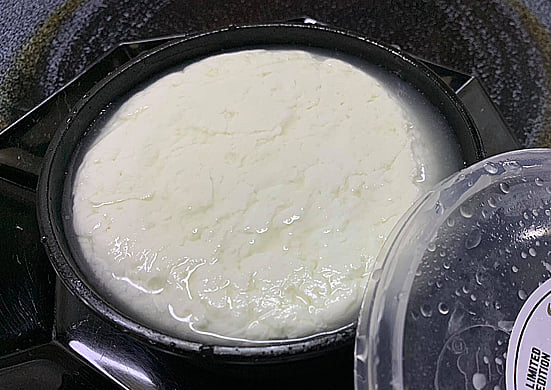
After a couple years of research and development, I reinvented halloumi into "Magdalloumi" in honor of Santa Maria Magdalena and my ancestral hometown,
 |
| Magdalloumi in brine |
At the start of July, as the Feast of St. Mary Magdalene approaches on July 22, the Magdalena Agriculture Cooperative (MAGCO) and I started earnestly collaborating to make and sell Magdalloumi. In small batches, MAGCO artisanally crafts the semi-hard, squeaky, salty and creamy cheese which is best served fried or grilled; then I bring it to market. It has been very well-received by a group of supporters and patrons on Facebook.
 |
Seared Magdalloumi w/ Honey-Kalamansi sauce
|
If I have learned anything in my continuing mission, it is this: a dairy enterprise requires a bayanihan effort. If "it takes a village to raise a child," it takes a community to grow and sustain an enterprise. Bringing milk from the dairy farm, transforming it into dairy products, and then putting them on a family's table is bayanihan at work. Currently, we only produce no more than twenty kilos worth of Magdalloumi per week, roughly 90 tubs of 250 grams each. but our Magdalloumi and kesong puti "ecosystem" involves healthy dairy carabaos, smallholder dairy farmers , government managers and technicians, milk processors, artisans, drivers, and cheesemongers, and cheese-loving patrons.So, as I work to sustain this community and find more customers for Magdalloumi, all I ask is that current and future patrons indulge me in my missionary zeal, in my kakulitan, to bring this savory food to the table.
###